
From Fabric Stash to Finished Design: How to Turn Random Fabrics into a Beautiful Quilt
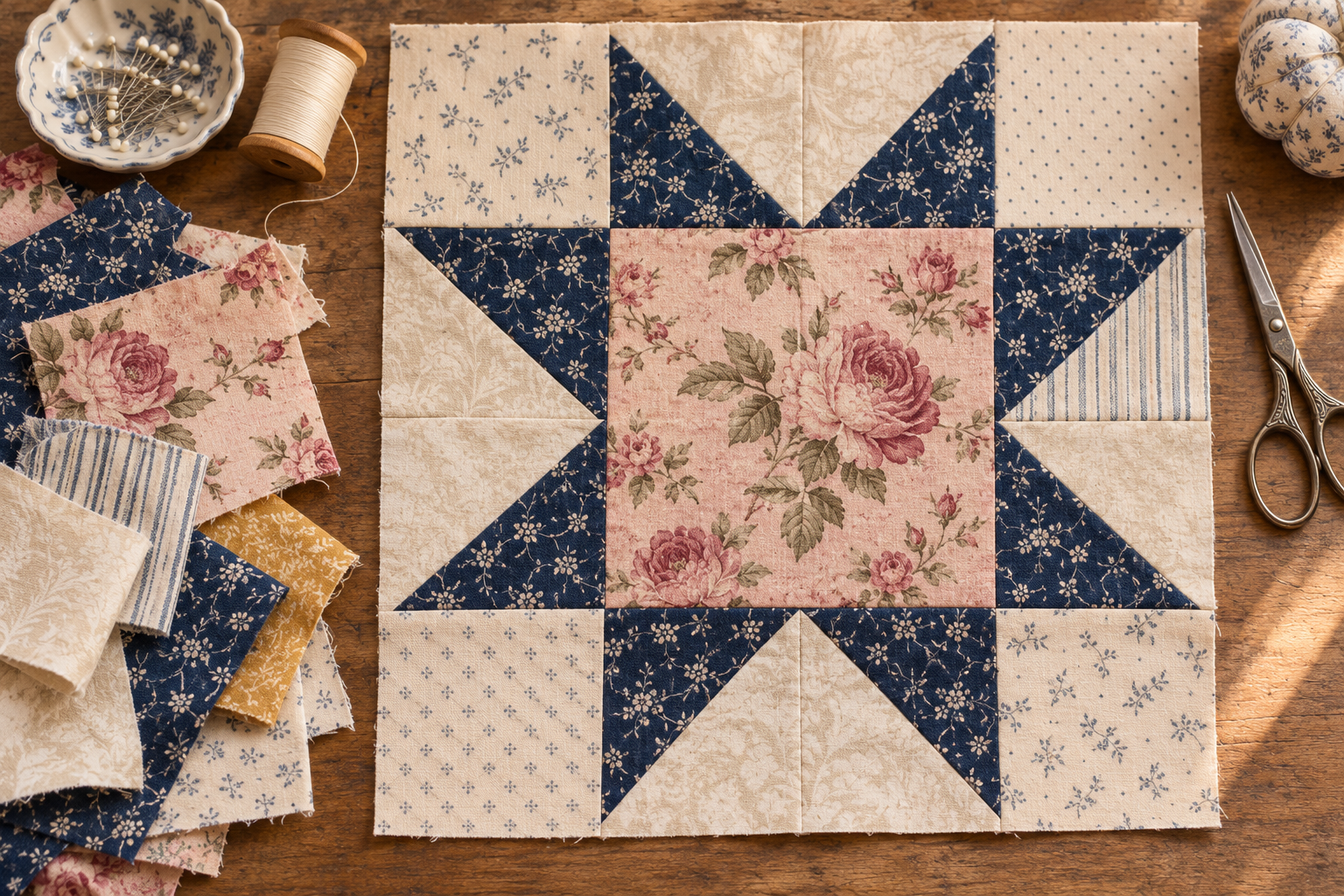
That last square of rose-print cotton has survived three sewing-room cleanouts. You still love it. There’s barely enough to wrap around a paperback, though, and the fabrics beside it are an odd little family. A strip of blue ticking. Two different creams. Some indigo calico left over from binding another quilt.
Put the rose print in the middle of a Sawtooth Star, give it indigo points and a pale background, and suddenly that pile makes sense. If you’re looking for quilt design ideas that use what you own, try starting with the piece you’d most like to see in the finished quilt. Then build one block around it.
Find a good window for your favorite print
Cut a square window in a piece of scrap paper and slide it over the floral. A small window might show half a rose and an intriguing curl of stem. A larger one might frame the whole bloom. Which would you rather see in the quilt?
That little audition helps you choose a block size. In a traditional 12-inch finished Sawtooth Star, the center finishes at 6 inches square. A 6-inch paper window shows what will be visible after sewing. If you like the view, check that you have another quarter inch of fabric on every side before cutting the 6½-inch square. Save the paper window. It’s handy for auditioning the other centers, too.
Let the scraps try different jobs
Set the floral on a pale cream fabric and fold a few indigo scraps into rough triangles for star points. Stand in the doorway and look back. Can you see the star from there? The difference in lightness between the indigo and cream gives the points their sharp outline. That leaves room for a busy print in the middle.
Now try the blue ticking in two places. Beside the indigo, a fine blue stripe on cream may look pale enough to join the background. Put the same stripe in the center of the next star and it can hold its own there, too. How a fabric looks across the room matters more than which pile you sorted it into on the table.
Repeat the part you want people to notice
For a nine-block table topper, lay out three rows of three stars. Put your only rose-print square in the middle star. Try blue ticking in the four corner stars and a small pink print in the four spaces between them. Stand back again. The little pink centers pick up the roses, and the stripes give your eye somewhere quieter to land.
Across all nine blocks, keep the points dark and the backgrounds pale. When the indigo calico runs out, try a dark blue dot or a piece of navy shirting. Two slightly different creams can sit side by side in the background. From the doorway you’ll see nine stars. Up close, you’ll see the different fabrics that went into them.
Photograph the layout while you still like it
Lay the center fabrics in their nine positions on a towel or design wall. Take a photo, then swap just two pieces and take another. Compare the pictures at thumbnail size. If your eye keeps going to a bold stripe in one corner, try moving it closer to the middle or repeating a little of it across the quilt.
This is also a good moment to share both layouts with the Quilted Minds community. Ask a specific question, such as “Which arrangement draws your eye to the rose print first?” The answers can help you decide whether the layout does what you hoped.
Once you’ve picked a version, sew the middle star first. Set it beside the remaining scraps and compare it with your photo. That rose print you kept for years finally has a place, and you can choose every fabric that follows by holding it up to a real block.
- Quilt Design Ideas
- Stash Quilting
- Scrappy Quilts
- Fabric Selection
- Sawtooth Star